How this course works
- Length: 12 teaching weeks, then an assessment week (expo and defenses) in week 13.
- Two sessions a week: the first is a lecture that generates and then verifies, live. The second is a practitioner guest; in a week without a guest it is a studio, where you work on your own project or contribution while staff circulate. Each session is 90 minutes; the plan is one cohort of 60 students.
- Three lines of work: six assignments (mostly in the first six weeks), four open-source contributions (across two repositories), and one term project (one or two people).
Twelve teaching weeks, then assessment
The course follows the public Fall 2026 calendar of Stanford CS146S, with two verification weeks added. Each teaching week has two 90-minute sessions: a lecture with live generation and verification, then a practitioner guest or a studio.
Explain your work without AI
CP1 in week 6 and CP2 in week 11 are thirty-minute, in-class paper checkpoints, each worth 7.5 points. The week 13 defense is worth 15 points: without a device, respond to a change or fault introduced in your own code during a fifteen-minute sitting.
Practise making a decision
Save a prediction before discussion, inspect a candidate or trace, run a discriminating check, revise after feedback and try a changed input. After checking, choose whether to accept, narrow, recheck or stop.
The full approach: the three lines of work, the checkpoints and the defense →
Syllabus at a glance
What you will be able to do
- LO1: Explain a coding agent's loop, system prompt and tool definitions, and predict how it fails on context, tools and stopping.
- LO2: Design an agent development workflow: context and specifications, MCP tools, skills, instruction files, hooks, subagents and background tasks.
- LO3: Write a requirement as a specification an agent can implement and a test can check, and revise it when new evidence arrives.
- LO4: Make an unfamiliar real codebase agent-ready, and deliver a change in it without breaking callers.
- LO5: Verify agent-written code with regression and mutation tests, code review, static analysis and security scanning, and defend each acceptance.
- LO6: Evaluate agents: check that a test can fail, that the denominator is complete and that a judge is reliable, and read small-sample results correctly.
- LO7: Recognise and mitigate agent security risks (prompt injection, credentials, supply chain), verifying a defense with a local reproduction and a regression.
- LO8: Describe how a team operates agents (portals, gateways, routing, cost), and how to recover from an incident and prove the recovery with a regression.
- LO9: Collaborate responsibly: follow upstream rules, disclose AI use honestly, submit no low-effort generated work, and decide again when the inputs change.
How the work is assessed
| Component | Marks | When | AI |
|---|---|---|---|
| Term project: four milestones | 20 | Weeks 2, 4, 7 and 12 | allowed |
| Project defense | 15 | Week 13 | off |
| Four open-source contributions | 30 | Weeks 4, 8, 9 and 12 | allowed |
| Six assignments | 15 | Weeks 1-3, 5, 6 and 10 | allowed |
| CP1: AI-off diagnosis, test and repair | 7.5 | Week 6 | off |
| CP2: AI-off review of unfamiliar code and recovery reasoning | 7.5 | Week 11 | off |
| Participation: guest questions, studio, expo | 5 | All term | — |
Passing requires at least 60/100 overall and at least 15/30 across CP1, CP2 and the defense.
Schedule
| Week | Topic | Due |
|---|---|---|
| 1 | The internals of coding agents | A1 |
| 2 | Advanced context engineering | A2; project proposal |
| 3 | Agent skills and the CLI | A3 |
| 4 | Customizing your agent and repository | Contribution 1; project technical specification |
| 5 | Agent-ready codebases | A4 |
| 6 | Agentic code review | A5; CP1 |
| 7 | Tests that notice a fault | Project alpha and task backlog |
| 8 | Security | Contribution 2 |
| 9 | Background agents | Contribution 3 |
| 10 | Evaluating agents | A6 |
| 11 | Building an AI-native team | CP2 |
| 12 | The software factory and what comes next | Contribution 4; final project |
| 13 | Assessment week | — |
A1–A6: assignments · Contribution 1–4: open-source contributions · CP1, CP2: 30-minute checkpoints on paper, without AI. The deadline for work due in a week is Sunday 23:59 of that week.
Videos
Short films, each showing one decision through worked examples: generate, then verify. They were made for the earlier edition of this course; the ones here still fit the current calendar, and each is listed under the week it supports. 7 films, 1 h 1 min in all.
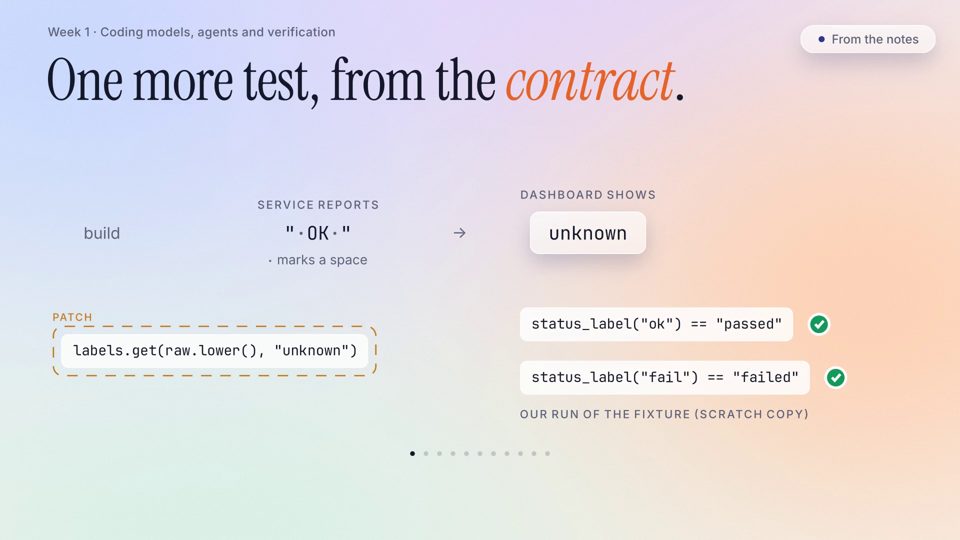 Week 1 · 6:36
Two green tests
The internals of coding agents
Week 1 · 6:36
Two green tests
The internals of coding agents
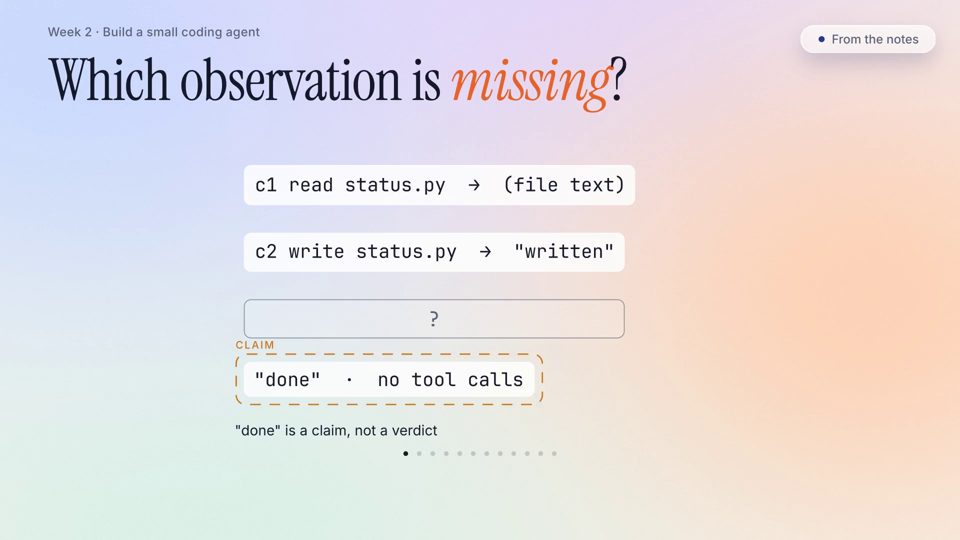 Week 1 · 9:37
Done is a claim
The internals of coding agents
Week 1 · 9:37
Done is a claim
The internals of coding agents
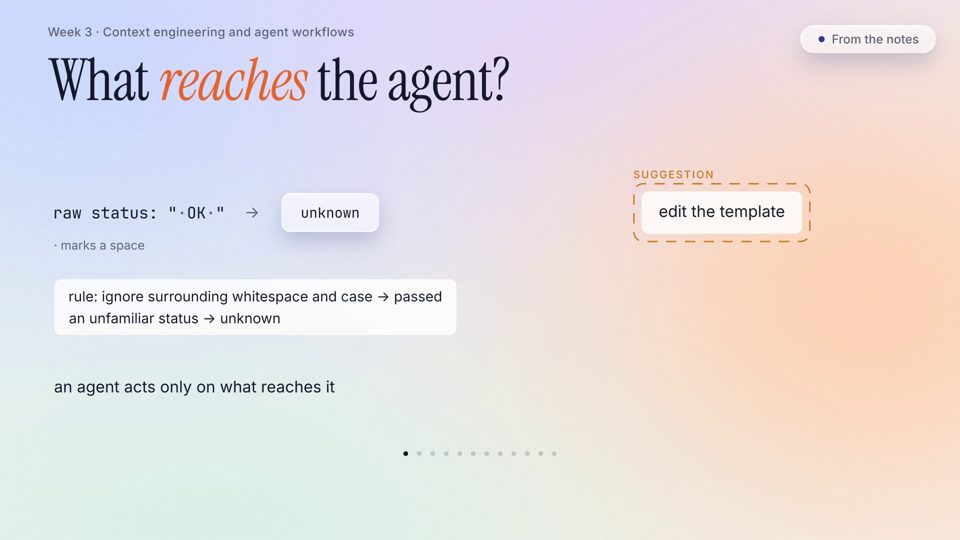 Week 2 · 9:27
Change only the context
Advanced context engineering
Week 2 · 9:27
Change only the context
Advanced context engineering
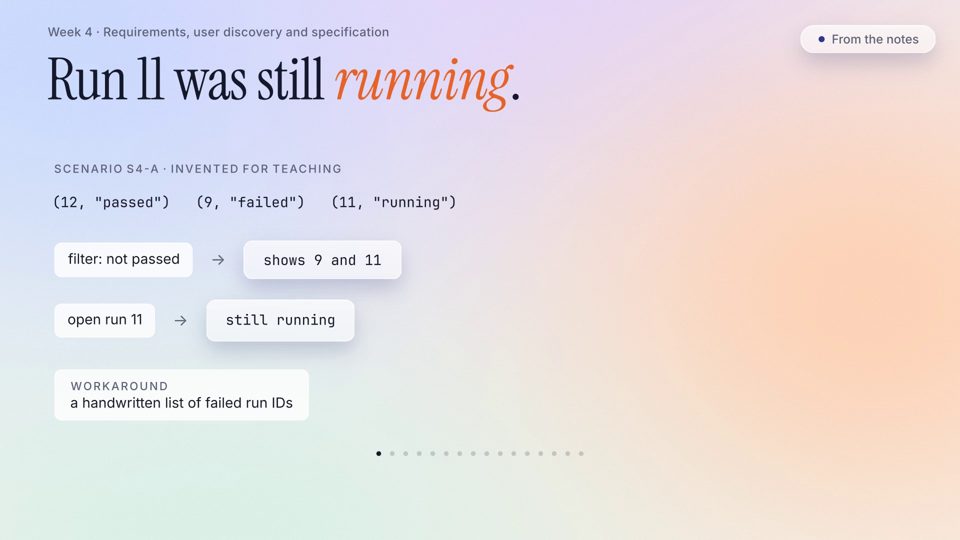 Week 2 · 8:51
Not passed is not failed
Advanced context engineering
Week 2 · 8:51
Not passed is not failed
Advanced context engineering
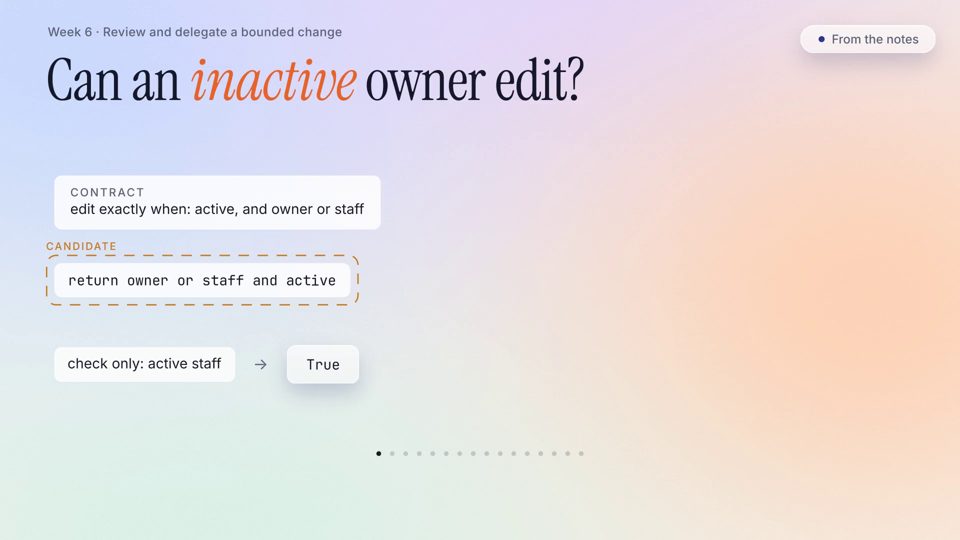 Week 6 · 9:37
Review before you ask
Agentic code review
Week 6 · 9:37
Review before you ask
Agentic code review
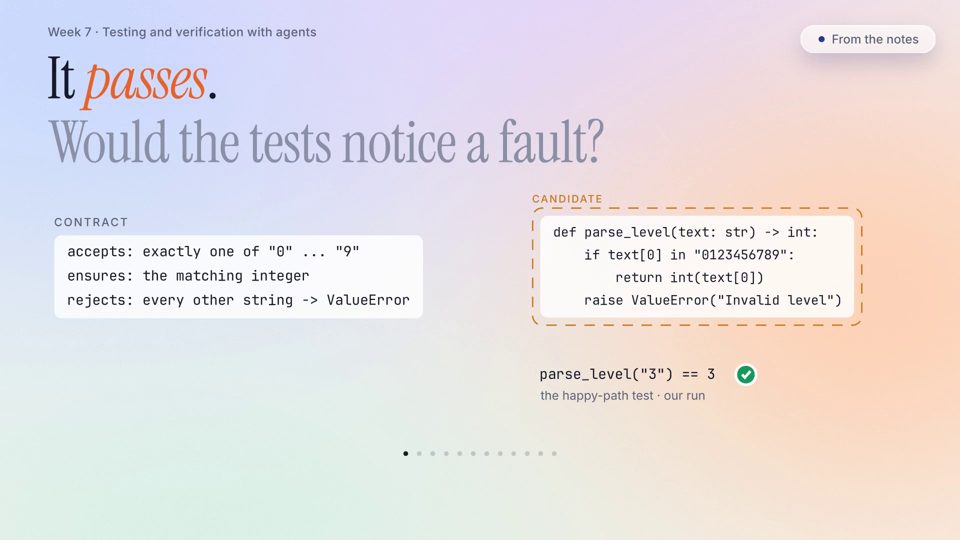 Week 7 · 7:32
Would the tests notice?
Tests that notice a fault
Week 7 · 7:32
Would the tests notice?
Tests that notice a fault
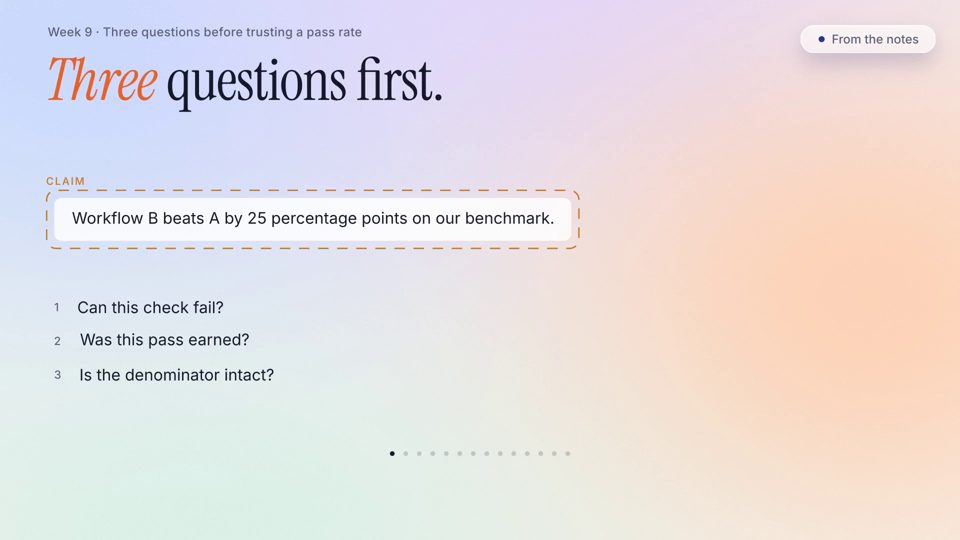 Week 10 · 8:58
Before you trust 25 points
Evaluating agents
Week 10 · 8:58
Before you trust 25 points
Evaluating agents
Course materials
Everything students work from is public: each week's notes, slides, activities, readings and self-check, the assignments, the term project, the rubrics and the assessment policy.
Course pages, lecture materials and rubrics are being rearranged to this calendar. Where another page still describes the earlier fourteen-week layout, the syllabus takes precedence.
Teaching team

Questions about the course: boxi.yu@ul.ie